Offices Are Empty. The Market Just Hasn’t Accepted It Yet.
A Market Correction the Industry Hasn’t Fully Accepted
At the start of this year, we explored the question of retrofit versus rebuild, examining what truly represents the most viable path forward in today’s market. More recently, we challenged the assumption that simply setting housing targets would solve the crisis, concluding that delivery—not ambition—is where the system continues to fall short.
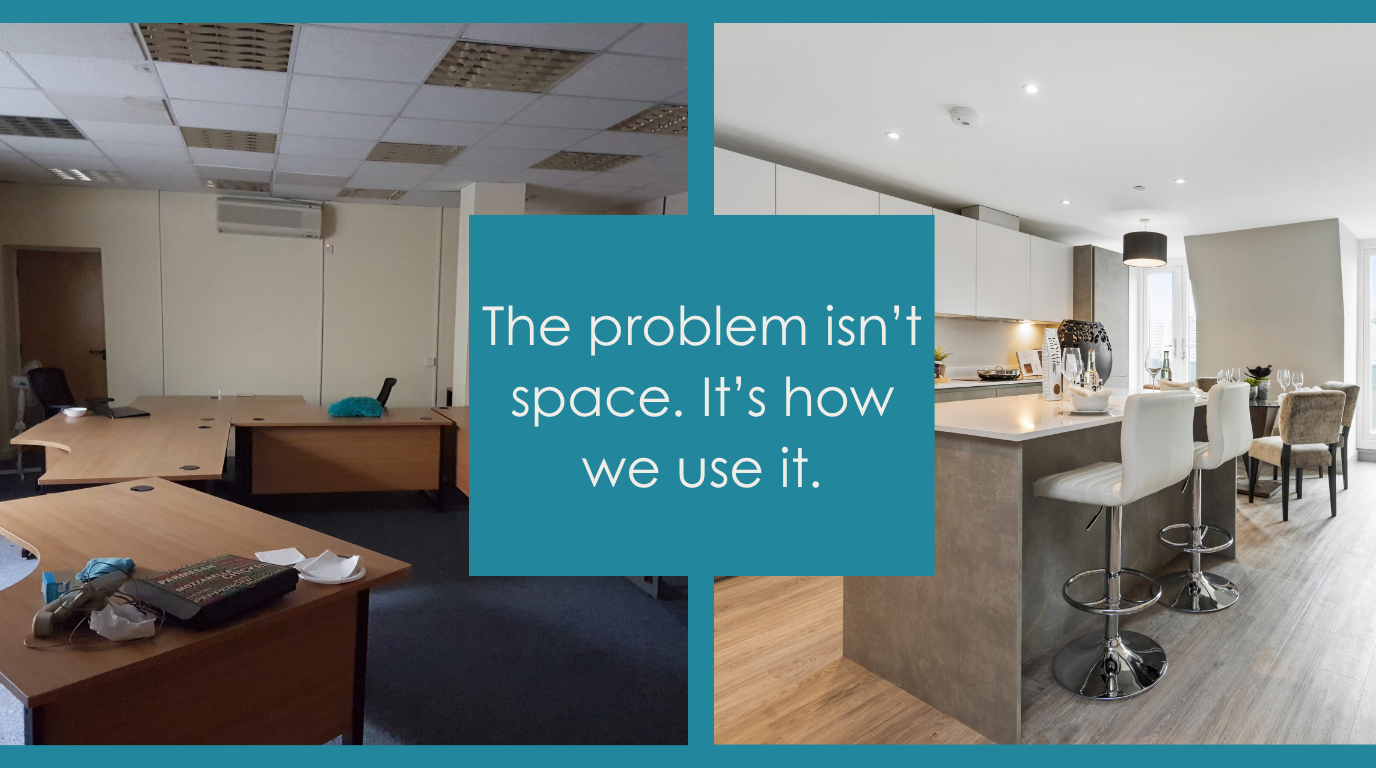
This raises a more fundamental issue, one that sits between both conversations but is often overlooked. The UK is not simply constrained by a lack of space; it is constrained by how inefficiently that space is being used. Across the country, a growing disconnect has emerged between underutilised commercial assets and rising residential demand, yet the two remain largely unaligned in both policy and market behaviour.
We are not short of space. We are misusing it.
A Market Out of Sync
Office occupancy levels provide one of the clearest indicators of this imbalance. Research shows that office utilisation sits at around 54% across the working week. Hybrid working has fundamentally altered demand, with businesses reducing long-term commitments, adopting flexible working models, and requiring significantly less permanent space.
This is not a temporary dip.
It is a structural reset.
Despite this, many office assets continue to be held and valued based on assumptions that pre-date these changes. The expectation of a full return to traditional office use still underpins pricing in parts of the market, even as real-world occupancy tells a different story. As a result, a significant proportion of office space remains underused, while capital continues to be tied up in assets that are no longer performing as originally intended.
Holding vacant or underutilised space is not a neutral position. It carries ongoing costs, including financing, maintenance, utilities, and security, all of which continue regardless of occupancy levels. Over time, these costs erode returns while also reducing the attractiveness of the asset to prospective tenants or buyers. As highlighted by MRI Software, vacancy represents a sustained financial drag that can impact both income and capital value.

A Growing Housing Shortfall
While commercial space remains underutilised, the housing shortage continues to intensify. According to the National Housing Federation, around 8.5 million people in England are currently unable to access the housing they need, including millions living in overcrowded or unsuitable conditions. This reflects not only affordability pressures, but a fundamental imbalance between supply and demand.
Delivery figures reinforce the scale of the challenge. Between April 2024 and September 2025, approximately 231,000 homes were added in England—well below the estimated requirement of 300,000 homes per year needed to keep pace with demand. This persistent gap has been widely discussed, including in our previous analysis, The 1.5 Million Home Illusion: Why Targets Don’t Fix a Housing Crisis, where we explored why headline targets alone fail to translate into meaningful delivery.
The gap isn’t closing. It’s compounding.
At the same time, the system continues to prioritise new-build delivery, often overlooking the potential of existing assets that could contribute to housing supply more quickly and efficiently. This creates a situation where both problems—underutilised office space and undersupplied housing—coexist, yet are rarely addressed together.

Mispricing and Marketing Inertia
In most sectors, sustained imbalances between supply and demand typically result in price correction. However, the office market has been slower to adjust, in part due to the structural and financial characteristics of commercial property. Valuations are often anchored to historic income levels, while lending arrangements and investor expectations can make it difficult to realise losses or reprice assets in line with current demand.
Put simply, the market has moved—but pricing hasn’t.
This has created a form of inertia, where assets are neither performing nor being actively repositioned. Instead, many remain in a holding pattern, with owners absorbing ongoing costs in the expectation that demand may recover. In reality, the shift in occupational behaviour suggests that this recovery is unlikely to fully materialise.
Capital is sitting still. And it’s costing money.
Conversion as a Value Reset
Office-to-residential conversion should not be viewed as a secondary option or a compromise. Instead, it represents a rational response to changing market conditions and a mechanism for realigning value with demand. Where office assets struggle to generate income, conversion offers a pathway to unlock significantly higher value through residential use.
In many cases, this uplift is substantial. Commercial assets that may achieve £100–£150 per square foot in their existing use can, following conversion, reach £300–£500 per square foot depending on location, specification, and design. This is not simply incremental improvement but a fundamental shift in how the asset is positioned within the market.
This isn’t adaptation. It’s repricing.
Beyond financial considerations, conversion also offers practical advantages. It typically enables faster delivery than ground-up development, reduces reliance on complex planning processes, and aligns with sustainability objectives by reusing existing structures. As we explored in our earlier piece on retrofit versus rebuild, the most viable solutions are often those that make better use of what already exists, rather than starting from scratch.
Barriers to Acceleration
Despite the clear rationale, conversion has not yet scaled to the level required to meaningfully impact housing supply. A number of barriers continue to limit progress, including planning complexity, regulatory requirements, design constraints, and funding challenges during the transition from commercial to residential use.
However, one of the most significant barriers is not structural.
It is behavioural.
Repositioning an asset requires a shift in mindset—from holding and waiting to actively adapting to market conditions. For some investors, this involves accepting that previous valuations are no longer achievable, which can be difficult in practice even when supported by market evidence.
The market has already changed. The question is who is willing to act on it.
From Opportunity to Delivery
Recognising the opportunity is only part of the equation. Delivering successful office-to-residential schemes requires a detailed understanding of design, cost, and construction, alongside the ability to navigate the practical challenges that come with repurposing existing buildings.
At headoffice3, we work with developers and asset owners to unlock value from underperforming commercial space, delivering high-quality residential schemes through intelligent conversion and fit-out. Our focus is not just on securing permission, but on ensuring schemes are viable, deliverable, and aligned with market demand.
Because ultimately, solving the housing crisis is not just about building more.
It is about using what we already have more effectively.
Offices aren’t just empty. They’re an opportunity.